Cover photo: one of Howell’s untitled paintings
The entrance into into art, for Howell, was largely influenced by woodblock printing and comic books. These different mediums became a springboard towards developing his own personal style. During school, he was able to get hands-on experience with the kind of screenprinting, inkblocks, and linoleum reduction tools he admired before, eventually becoming interested in painting. What sets a lot of Howell’s work apart from other paintings is its connection to a certain Japanese art style.
The work featured in Red Raven Espresso Parlor and Fargo, North Dakota’s The Erotic Art Show had a strong connection to the Japanese ero-guro artistic movement. The ero-guro movement was one of decadence, and though it often had nudity and gore as a major shock-value aspect, the style itself was not based solely around these concepts. The result of all these disparate influences is one of bizarre and at times heavily symbolic work that spans both visual and literary art. Howell’s paintings evoke the ero-guro style’s heavy use of symbolism, while also making commentary on aspects of society not found in the Japanese style. Howell’s work often centers around gender issues, religion, and death—there is always a healthy dose of the macabre present in his work. Howell’s mention of horror films and “slowly accepting my own morality” were aspects that I found particularly evident when looking at his work. Through his paintings Howell seeks to express both himself and his lived experiences, while also speaking to the arduous nature of these experiences.
Some of ero-guro’s most prolific names like Edogawa Ranpo only wrote, while others like Junji Ito and Suehiro Maruo write and draw their own comics; the latter of the three heavily inspired a portion of Howell’s earliest work. Howell once said about Shit Soup by Maruo: “Before I draw anything, I read this short comic. It’s one of the filthiest, most beautiful pieces of work I will ever read.” This duality of beauty and filth shines through in all of Howell’s work, absorbing both his ugly and beautiful experiences with the world and then transforming them into art.
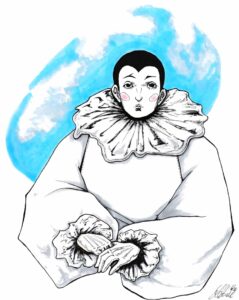 .
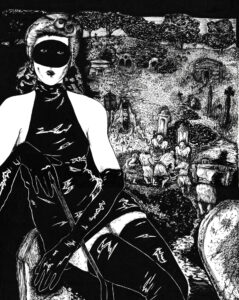
(above) Two of Howell’s untitled pieces
How do you think you’ve changed over time as an artist?
I would say I’ve gotten a lot better at composition with my work and expression in my work, I’m not over-detailing, I know more of what I want with some of it. I just wanted to do traditional illustration before, but now I’m more into the expression and symbolism and a lot of those artists.
Do your materials influence your art, or is it more of the other way around?
It’s the other way around, my materials create limits, but they also allow me to feed into the process more. I just love doing little lines, that’s one thing that keeps me away from painting, just it takes away my lines.
Could you talk a bit about the religious influence in a lot of your work, and where that influence came from?
A lot of it has been inspired from thinking more on my upbringing—I grew up surrounded by Catholicism. When you walk into church there is like bloody Jesus and other crazy sculptures and paintings like that; it just sticks in your head. I’m able to get something out of something that was just sort of propagated into me as a child, like using those feelings of guilt and shame, taking them away from it while admiring the beauty of it still.
Where does the inspiration for art come from now?
My inspiration is more focused in, rather than it being changed or altered in some way, and I’ve definitely got into learning my own experiences and how they relate to my art. I’ve been really into William Blake’s Dante paintings lately.
Has moving from Minnesota to New York City affected your creative process and inspiration at all?
Yeah, I went from having a full office—a full studio space for all of my things, but now I just have two easels in the living room, and whenever we want to watch TV or a movie, they’re right in the way, so then I have to move them. So it’s definitely something I’m still getting used to…for inspiration, I think it’s more shifted because of my experiences and getting older rather than the act of moving itself.
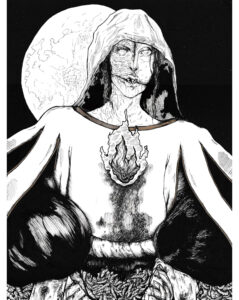
(below) Worms, Lauren Howell
written by Brady George.